|
Not Quite a Biography of Patrick Jennings
Well, I'm going to assume that like most people when you ask,
Patrick, where are you from?
you won't be satisfied with the answer,
Spuzzum, BC
even if it were true (I've never lived there and have been known
to lean on the gas-pedal a bit when passing through). "Where are you from?"
isn't at all like the question "How're ya goin', mate?" or "How'dya feel?"
questions for which an honest and full accounting are neither expected,
nor appreciated. No, "Where are you from?" is not so much about where you're
living now but rather "What's your home, the place you identify most with?"
People don't realize they're being intimately philosophical
when they ask such a question. That's because most people live one or
two places their entire lives and answer the question by naming one of
them. It usually takes such people awhile to figure out that my first
response—where I'm paying rent at the moment (currently Deep Cove, near
Vancouver, Canada), or my last 'permanent' mailing address if I'm traveling
(Whistler, Canada)—doesn't really respond to the query they had in mind.
See the question is really just a conversational kick-start. It leads
to other seemingly harmless questions, such as
What do you do?
Under some prodding, I go on to fill in some of the larger details
from of the last few years of my life. I might say, for example, (take
a deep breath) "I spent most of '94 and '95 traveling through Australia
and SE Asia which seemed a good way to recover from several years in Vancouver
bound to a keyboard, code-jockeying for the likes of IBM, Microsoft and
other, decidedly-smaller, software ventures." And they're satisfied
. . . for a while. Now we can move onto more interesting things,
like the weather, or how great it is that Vancouver now has a Basketball
Team of its very own.
During the course of conversation though, it usually becomes
clear that Vancouver isn't where I'm from and that writing the
software that makes other people billionaires isn't what I do.
The realisation usually comes about when talking of ski-bumming for a
couple years in Whistler, or it's casually mentioned that I've no intention
of writing other people's software ever again; or if I describe the Autumn
colours of New England where I grew up; or brag about playing tackle
football without pads in New Jersey, where I also grew up, or reminisce
my first attempt at 'higher education' as a Photographic Arts
and Sciences major at Rochester Institute of Technology . . .Oh
heck, practically anything I mention about my past is likely to trigger
an avalanche of questions leading in a somewhat randomly reverse chronological
order to my birthplace (Baden Baden, West Germany), how my parents met
(at a dance when they were 16—still together), and why I'm a Canadian
citizen if I was born in Germany and grew up in the USA (Canadian Citizen:
Because Mom & Dad were Canadians and registered me as one when I was
born; Germany: Dad's RCAF assignment; USA: Dad's post-RCAF employment
piloting TWA jets).
This creates a curious mixture of alliances so that I root for
Canadian Hockey teams and Baseball teams; and I root for German Soccer
teams; and I would really love to up-root the USA
and put it on a small Island in the Aleutians where it wouldn't be so
dangerous—well most of the people can stay but the government, industry
and media elites have gotta go.
By this point in the conversation people have just about given
up getting a straight answer on the place I identify most with
but there's that other question fixed in their minds that surely I must
be able to answer,
And just what is it you do
anyway, Patrick?
Well, right now I write and construct these web pages though
nobody's paying me to do so which means it doesn't really qualify as an
answer. Infact, nobody's paying me to do anything, which of course leads
to more backward propelled questions. Not that I mind the inquisitiveness
at all. I love the attention. Perhaps it would be easier on everybody
if I could permanently answer that burning what do you do? question
for myself.
What perplexes these people is that the sum of the various vague
and seemingly misrepresentative responses I give to all their queries
add up to but two facts:
- I'm not from any one place
- I don't do any one thing.
For some reason, many people are uncomfortable with this state
of reality. I believe myself to be among the freest, dare I say happiest,
people on earth. Pascal said, "Our nature lies in movement, complete calm
is death." And so, I am a Nomad. Not just a topographical wanderer but
a philosophical journeyer and occupational rover. When I say 'occupational
rover' I'm not referring to a sort of 'serially monogamous' relationship
with income-earning employment. I mean literally how I keep myself occupied.
Earning an income is just a necessary evil so I can afford to do the thingsI
like to do and go the places I like to be. In particular, this past year
roving through SE Asia and Australia really drove that message home. The
journey I enjoy most though is the internal one. The mind, heart and soul
of self constitutes a vast and ever-fascinating terrain for mental strolling.
But you can't tell people you're a nomad and expect them to understand.
Sometimes I'm feeling particularly alert and expressive and when
people then ask me,
Patrick, where are you from?
I tell them that's a hard question to answer and ask whether they're
really interested in the whole story. I'll launch into it, into the whole
thing, from my teen-age father hitch-hiking between Etobicoke, Ontario and
Montreal, Quebec just to spend weekends with my mother, right through to
my finishing touches on this page  even why I'm bothering to do it  for anyone willing to sit it out. But, if they respond, "No, not
really, I just want to know where you're from," then I say,
Spuzzum, BC
I figure they might as well be asking, "Howzit goin?"
They don't really want to know; and Spuzzum's about as bland as the "Fine."
kind of response they're looking for. I'm not sure if I have the patience
to answer those kinds of questions right now.But I'll banter for hours about
places I've been and places I want to go, about things I've done and things
I've not yet done.
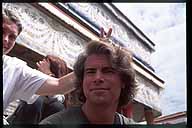
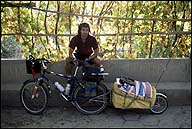
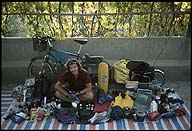
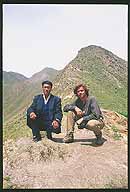
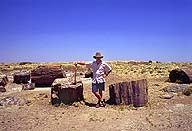
BTW: The pictures are all of me.
BTW2: I've been asked if the town of Spuzzum is metaphorical
or real. It is very real. It is beyond Hope.
BTW3: This existential ramble is continued at "Where
to?"

Comments
David Buchanan
12 Jun 2009, 16:28
Hi Patrick:
Discovered your "Nomadic Spirit" site while searching for things related to
Robert Pirsig's work. I'd like to suggest that you put up a link to
robertpirsig.org, which is operated by the world's only Ph.D. in Pirsig's
philosophy. In the interest of full disclosure, I should say the operator
is a friend of mine and some of my essays are "published" at that site.
I read you short piece about how Lila is a complete reversal of Zen and the
Art and have to say I disagree. As Pirsig sees it, Lila is the more serious
book and ultimately the Quality he talks about in Zen and the Art is left
undefined. One of the important advantages, I think, in the second book is
that he fully explains WHY it can't be defined.
For whatever it's worth, I thought it might be nice to say hello to a
fellow fan.
Cheers from Denver,
Dave
Patrick Jennings
17 Jun 2009, 22:14
Thanks for the suggestion, Dave. I'll get that link up next time I update
the page.
Hmmm...I did have entirely different take on Lila. It felt to me like
everytime Pirsig would say, "..this has quality..." and gave reasons why, I
often disagreed with two things: that the object or subject had any quality
whatsoever, and the reasons for why.
Perhaps it's a bit like Plato's Republic, which sets out, if memory serves,
to answer the question, "What is Justice". Socrates points out that any
definition of Justice falls short of describing all the conditions under
which Justice exists. Instead, he says, let's see what a just society might
look like, and define Justice as those sets of conditions that create one.
The problem is, the society seems to us, now, as quite unjust. So as an
explication of justice, it falls short.
Much the same with Lila, I think.
Cheers!
Patrick.
Samuel Augustus Jennings
18 Jul 2010, 16:55
Patrick, are you related to Preston Jennings of Vancouver who has a sister,
Marlene Jennings, who is from Montreal and was elected to the Canadian
Parliament a few years ago?
Samuel Augustus Jennings
18 Jul 2010, 16:57
Were u the Production Designer for "Floored by Love" tv movie?
Patrick
20 Jul 2010, 01:47
Hi Samuel,
Yes, that was me. I had a the pleasure of working with a spectacularly
talented and generous crew. :)
But, regarding relatives, not that I know of.
kay
30 Sep 2010, 18:54
Hi Patrick
I just read your comment on Milgram's Obedience to Authority experiments. I
think you'll find many who disagree with your reading that these
experiments are evidence for a biological imperative to obey authority.
Milgram (a social psychologist) himself linked his findings to a 'theory of
conformism' (notably applicable only to those without expertise or
abilities) and 'agentic state theory' where an individual comes to see
themselves as the instrument for carrying out another person's wishes.
Both of these lend themselves to traditional behaviourist and other
socialisation readings rather than biological ones. Moreover, a biological
imperative argument would need to explain the 40% or so of participants
that refused to obey at some point.
But this brings us back to the endless nature-nurture or agency-determinism
debates, which have entrapped the human sciences. Many scholars have tried
to escape this dualism. Foucault is among those who have focused on social
practices as ways to put these debates aside, if not escape them. So I
think you may be misreading Foucault in arguing that Milgram’s experiments
provide a caution or challenge to Foucault’s approach. Although Foucault
was openly sceptical about the project to discover ahistorical constants in
the human sciences (and it wasn’t a question he was interested in) he also
doesn’t make big claims about their existence or not (as in relativist
approaches) but rather brackets out these questions in his studies and
instead tries to see how far his approach can show/explain the historical
constitution of the experience of the subject in a particular localised
domain of practice.
So Foucault is also not a grand theorist of power (something which he
eschewed) but more a local empiricist of historical thought-practices like
archaeological objects (whereas Milgram’s empiricism focused on behaviour).
He thought of his claims about the way power techniques are entwined with
knowledge as working conceptual tools subject to revision and adaptation
depending on their relevance or usefulness to the historical and social
context. This power-knowledge conceptualisation was developed in relation
to contemporary Western culture with its peculiar emphasis on truth as a
key adjudication authority and he cautioned against simply assuming that it
would be as useful or applicable in dissecting other cultural contexts.
I personally think that Foucault offers a more promising way of approaching
Milgram’s findings. Rather than looking for determinist (social or
biological) laws of human behaviour, a Foucauldian approach would focus on
identifying the specific (historically situated) practices for governing
the self and for governing others that could explain patterns in both
conformism and resistance to authority in the ‘experiences’ of the
participating subjects. Rather than pointing to ahistorical imperatives,
they would identify the particular disciplines of the self that are drawn
upon in familiar situations of assymetrical relations of power
(teacher-learner; scientist-assistant; expert-ordinary person) which invoke
quite regular expectations in styles of comportment on all parties
involved. So familiar that they constitute a key part of the subject’s
'experience' of the situation.
I suspect that if the experiments were to be repeated on Gen Y people
today, the results would be rather different – even the basis for
conformity would be different. It has been widely acknowledged that since
the 1960s (at least) there has been widespread challenges to local forms of
authority and expertise in Western societies (including against ‘experts’
and scientists). In fact Milgram’s research questions themselves could be
understood as part of that nascent movement questioning the social
assumption that obedience to authority is a social 'good' (which the Nazi
phenomenon did much to discredit). It’s also clear that this has had clear
practical effects on how figures of authority and subordinates are expected
to conduct themselves these days. There are not uniform changes but there
are some common themes such as the shift to democratic leadership styles,
anti-elitism, authorities having to give reasons for decisions (greater
transparency), greater accountability of authority figures, subordinates
expected to take more responsibility and to act empowered and
self-directing etc, a general shift that valorises greater participation in
debate and decision-making etc. All of these you can see have been
producing new forms of tension in workplaces, in political relations etc.
Patrick
30 Sep 2010, 22:31
Hi Kay,
Thank-you for your intelligent and thoughtful post.
I wouldn't ever confuse myself with a Foucault scholar, so I'll defer to
your knowledge on that.
What I will defend is a portion of the statement to which you refer:
"...power (authority) as we respond to it as individuals is apparently
subject to a biological imperative..."
I'm careful there, in a brief statement, to allow all the other imperatives
to which we are subject: social, psychological, conscious, subconscious,
intellectual, spiritual... Any theory attempting to explain the human
response to authority which fails to consider all these avenues will fall
quite short of the mark. Moreover, would be silly to suggest any one of
these provides the primary factor. No one of these explains Milgram's
results.
My point is, primarily, that we human beings don't like to see ourselves as
driven by biological imperatives (instincts) of any kind, even if that
imperative is as distinct as seeking a nipple in the first moments of life
outside the womb. We prefer the ideal that we are conscious, intelligently
rational creatures of free will and self-awareness. Our fall back position,
when that fails to explain our behaviour, is the subconscious.
We like to think that way, I believe, in part, because it allows us to say
to ourselves, "I would never do that." Or, "What kind of monster would do
such a thing?"
Milgram's experiment was reproduced dozens of times by numerous
experimenters around the world for over a quarter of a century in numerous
locales, countries and cultures. The last trial was held in 1986, after
Vietnam, the peace movement, Watergate, Solidarnosc and just 3 years shy of
the collapse of the Soviet Union, perhaps the greatest authoritarian empire
ever mounted. Yet the results of all these trials over that entire 26 years
remained consistent with Milgram's original findings in 1960.
I doubt that would surprise Milgram, who observed that his subjects'
behaviour was demonstrably independent of any social, intellectual or
spiritual factors.
Milgram characterised "obedience" as running the full series of shocks
including three at 450volts given to an apparently unconscious learner.
Interestingly, though, at 150volts, the learner complains of the heart
condition he'd disclosed at the outset of the experiment, and demands that
he be allowed to withdraw. Depending on the particular circumstances of the
trial, nearly all the teachers obey the instructions of the experimenter.
Cheers,
Patrick.
kay
30 Sep 2010, 23:16
It will take a lot more than than resistance to the current cultural bias
towards flattering subjectivist accounts to convince me to accept the old
determinist route instead. The failure of one account doesn't make it's
factional opposite any more correct. Perhaps it is the dualist conception
that is problematic... Many current thinkers believe so.
But as a graduate of psychology we spent much of our time critiquing psych
studies and it was rather too easy, in my opinion, to find problems in the
assumptions and theoretical over-interpretation of the vast majority of
psych studies - Milgram's (and post-Milgram) experiments included. And in
this case I remain skeptical of your claim that these experiments show
subjects' behaviour as 'demonstrably independent of any social,
intellectual or spiritual factors'. That's a very big claim. I'm not aware
of any psych study of social behaviour, esp at this level of complexity,
that has ever convinced a sufficient majority of academic psych scientists
of it's biological determinism to make such a claim without producing a lot
of academic heat.
Personally, I can think of a number of questions I would need to have
answered and alternative explanations that I would need to rule out before
I could be convinced. Not least is that I really can't imagine that Hitler,
Schmitt, Stalin, Nietszche or Napolean, as celebrity examples, would even
agree to be part of Milgram's experiments let alone unflinchingly submit to
that form of scientific expert authority. And I don't think they have
different biology.
This is one of the problems for the human sciences that thus far there are
few, if any, techniques for separating nature/nuture that are infallible or
produce indubitable results. Where they get close - these are usually at
such a basic level (like a baby's nipple reflex) that it is generally not
very helpful for understanding key social questions (not matter that
evolutionary psychologists and socio-biologists persist). But, no matter,
it keeps the human sciences in business.
Dina
22 Nov 2010, 00:34
Hi Patrick,
I found your comments about Zoom search software in Martin's cpshop forum.
I've been trying to get this software work with my site too
(militarygallery.net), but it doesn't accept my images. The reason is that
the product images are read as:"...external site, doesn't match URL" Of
course I can't change that, the file name is determined by the cpshop
script. All I have is a cpshop template, not separate pages with products
and their images. I would really appreciate, if you give me some advice and
help me figure it out. If you help me fix the problem, I will make a
generous donation to Nomadic spiriting. By the way I find all your sites
very interest!
Thank you so much in advance.
Sitting Owl
20 Jan 2011, 23:34
Namaste' Patrick
I came across your website looking for more info on Chief Seattle, and
thank you very much I found heaps and have added it to my Chief Seattle's
page at: www.sittingowl.com.au, with acknowledgement and links back your
site, of course.
I found it interesting that you basically hale from BC Canada; presumably
around Vancouver. I have relatives there. Also interesting that you have
travelled Aust. and obviously picked up some of our slang: How ya goin
mate?
Well I'm doin great mate and apart from my own website and forum have been
busy doing ceremonies, counselling etc., basically some serious sharing
with some of my brothers and sisters. As well as living as close to Mother
Earth as is possible these days, in a caravan (trailer) out in the bush
(forest) near Ballarat Victoria.
Anyway I thank you for your sharing and wish you many blessing from Great
Spirit. Maybe one day we might catch up in person, but we are one anyway.
Yours in Spirit
Sitting Owl
|
|
|